Is NetBrain Right for You and Your Organization?
Download the whitepaper, “Reduce Network Downtime by Half Every Year—The Promise of AI-based Automation for Modern Network Operations” and explore the quick checklist to help you decide.

Data is not the problem. What you do with it is.
For years, network teams have lacked insight into downtime even with…
More telemetry.
More dashboards.
More alerts.
…
And yet, mean time to resolution (MTTR) has not meaningfully improved. It still stretches into hours, and the same incidents return—often driven by configuration drift, fragmented tooling, and human-dependent troubleshooting.
The real gap is not data. It’s converting tribal knowledge and manual processes into reusable intelligence and repeatable automation.
Network monitoring tools alert you something is wrong:
But, they stop at telling you where and why—and how to find similar occurrences across your network. Unfortunately, this is not possible with today’s manual NetOps processes, pulling context, tracing paths, comparing configs, and figuring out if the issue has been solved before and by whom—- due to limited skilled staff. This situation is resulting in prolonged outages, recurring incidents, and slow resolution cycles.
This is where automation comes in. Its aim is to fill the gap in managing operations in growing network complexity. They span physical infrastructure, hybrid/multi-cloud, SD-WAN, and dynamic workloads like Kubernetes—often with increasing application dependencies layered on top. Without automation, downtime persists. But automation alone has been difficult to adopt and use. Automated scrips and, even no-code automation, have learning curves that impede adoption.
Powered by agentic AI, NetBrain’s 5th-generation platform pairs its intent-based automation with agentic AI and its live digital twin technologies. This AI acts as a PhD-level network engineer—diagnosing issues, assessing vulnerabilities, and executing network changes safely. It learns from engineers to orchestrate thousands of tasks at machine speed and increases its knowledge with each outcome.
Future-ready network automation starts with a shift from visibility-first to automation-first:
That’s why NetBrain’s founder wrote a whitepaper outlining an automation-first operating model focused on a measurable goal: reducing network downtime year over year through systematic, intent-based automation—accelerated by AI.
The goal is to cut network downtime measurably by reducing the average time to resolve every issue and the total number of tickets. The stakes are high, as the per-hour and per-incident costs in modern enterprises are substantial.
Cutting downtime results in these outcomes:
The method below is designed to do both—systematically.
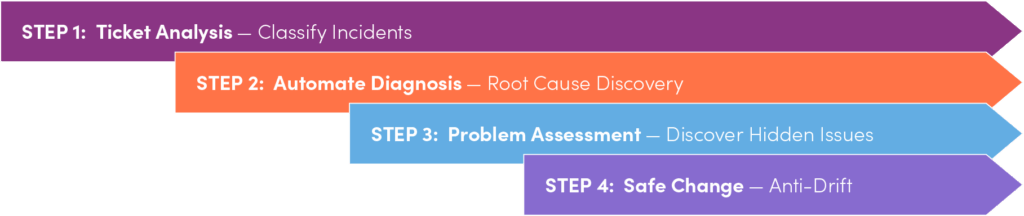
The most logical place to begin is analyzing your existing tickets. Every organization already has the raw material for operational improvement: ticket history.
Just as a doctor analyzes patient records, automation and AI analyze past tickets to get a foundation for troubleshooting future incidents. By analyzing past incidents, teams can identify the handful of ticket types that consume the most time and recur the most frequently. The goal is continuous improvement and lower MTTR.
Intent-based automation and reusable runbooks move diagnosis from “tribal knowledge” to an operational asset.
The path to comprehensive automated diagnosis requires a “shift-left” strategy: systematically moving diagnostic work from engineers to AI. This is achieved by building intelligent, executable runbooks for each incident type. These runbooks combine automation nodes—for commands, configs, assessments, and AI-generated summaries—into a transparent “white-box” system. Here, AI orchestrates the workflow, reasons through outputs, and pinpoints root causes, blending human expertise with machine precision.
This structured approach enables diagnosis that is exponentially faster and broader, making 99% problem coverage a tangible goal. The same assets can also power fully autonomous “black box” AI, achieving similar accuracy without human intervention.
Even strong diagnosis will not reduce incidents unless you learn from each failure.
During post-mortems, teams codify the root cause into an assessment that can be run across the environment to answer a simple question: “Do we have more instances of this problem elsewhere in the network?”
Over time, this shifts operations from reactive firefighting to proactive discovery—leveraging industry-wide outage knowledge in their own network to prevent outages.
If you want fewer outages, you have to minimize drift.
A practical approach is to validate changes against “golden” expectations—before and after changes occur—so drift is caught early and doesn’t silently accumulate into risk.
When drift control is in place, teams can start standardizing frequent change workflows so repeat changes become safer, faster, and more consistent.
The newest generation of network automation builds on a digital twin foundation using AI as always-on engineers to accelerate outcomes: orchestrating automation at scale, interpreting results, and helping teams move faster while staying explainable.
In other words: AI doesn’t replace operational workflows—it accelerates them.
Network automation does not fail because teams lack data. It fails when data lacks insight while trapped in static dashboards, manual runbooks, and individual experience.