The Substitution Decision: How Agentic NetOps Changes What You Need From Your Network Team
The best teams at the 2026 World Cup won’t be the ones with the most stars. They’ll be the ones with the best depth and support strategy. Great teams win...

Every security leader knows the crushing reality of alert fatigue. The day starts with hundreds or thousands of notifications vying for attention. Security teams are drowning in inefficiencies, where critical threats become needles in a digital haystack. The pressure is mounting and for good reason. Third parties are accelerating attacks with AI and advanced tools. According to the Cybersecurity and Infrastructure Security Agency, in 2024, business email compromises alone cost businesses more than $2.7 billion, with small and midsized businesses particularly at risk because they may lack the resources to dedicate to cybersecurity.
This pivotal shift to more advanced attack tools means that by the time an engineer creates a support ticket or investigates a suspicious event, an AI-powered attack may have already exploited the network. The stakes are higher, and the timelines are unforgiving. To match AI-enabled threats, organizations need defenses with speed, scale, and the ability to act.
The exponential rise in AI-driven attacks has left the traditional workflows that rely on command lines and spreadsheets dangerously outdated. Patch windows are closing, yet the gap between known vulnerabilities and actual mitigations continues to widen. Security teams often must defend against an onslaught of AI-augmented threats using tools made for a different era.
This gap spans beyond technology, impacting operational sustainability. Reboots of the same old processes cannot keep up when exploitation timelines can last mere minutes. Recent findings from the IBM 2026 X-Force Threat Index highlight that identity-based attacks are becoming faster and more sophisticated, with attackers leveraging AI to pivot laterally and escalate privileges before transitional monitoring even registers an alert. This is why human effort alone cannot contain modern threats. Teams must achieve speed and scale through advanced, automated capability with AI as a true partner to the security team.
It’s easy to associate AI in network security with anomaly detection or basic pattern matching. However, agentic AI network security represents a paradigm shift in which AI becomes an operator rather than a passive observer.
In practice, this means that when an alert surfaces, agentic AI launches an investigation, correlates data across sources, pinpoints the root cause, and often drafts remediation steps itself. Where traditional AI might notify teams that a device is showing unusual login behavior, agentic AI responds with more insights. For example, agentic AI might inform your team that a device was accessed with stolen credentials traced to a phishing campaign and encourage you to isolate the device and reset credentials for the affected user.
Such capabilities move AI-based network security into the realm of digital engineering assistance, driving problem-solving, action planning, and direct execution.
Organizations must go beyond basic detection and embrace a comprehensive, AI-driven strategy to move the needle on network security. The following pillars illustrate how integrated AI capabilities transform security programs from reactive to proactive, delivering speed and resilience in the face of evolving threats.
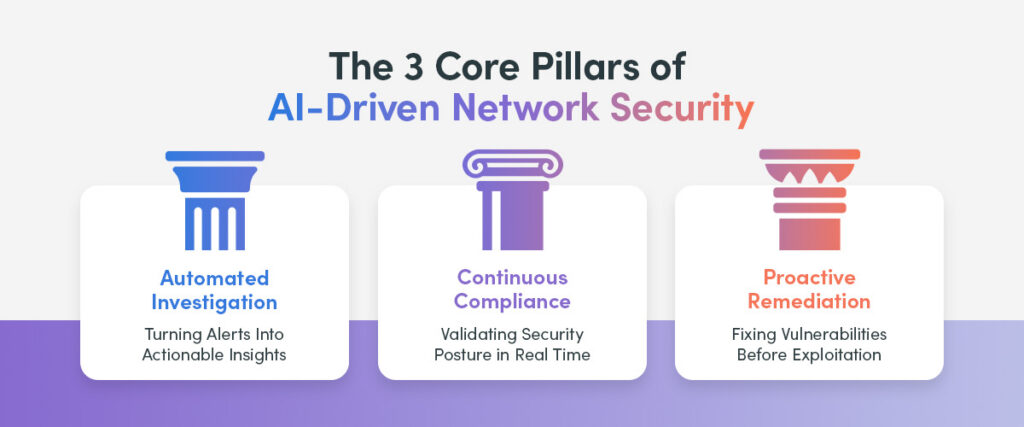
The real cost of alert fatigue is the time teams spend manually addressing incidents. Modern AI and network security solutions instantly trigger investigations once a new alert emerges, mapping out the attack path within seconds. NetBrain’s triggered auto-diagnosis feature is a prime example, where the system rapidly identifies the blast radius and potential lateral movement. The outcome is a plummeting mean time to resolution (MTTR) as your solution eliminates tedious data collection. Engineers focus on high-value analysis and response, rather than gathering logs or reconstructing events after the fact.
Teams can no longer rely on periodic audits to achieve network compliance and security. AI-based network security now enables continuous posture validation, where solutions check configurations against golden security intents 24/7. AI continually evaluates whether the real network state matches desired intents, flagging and correcting deviations.
Ultimately, the goal of agentic AI network security is proactive remediation. Misconfigurations remain a leading entry point for attackers. AI-driven systems stand apart by continuously scanning for configuration drift and automatically recommending or executing rollbacks to the baseline. This level of proactivity means teams can fix vulnerabilities before they ever become a line item on a breach report.
Integrating AI into a network security strategy requires a structured, pragmatic approach that aligns technology with business needs. To maximize effectiveness and ensure lasting impact, organizations should focus on core principles that guide implementation while maintaining control and transparency at every stage.
You cannot secure what you cannot see. The first step toward effective AI in network security is building a real-time digital twin. This living map of the network should reflect current topology, traffic flows, and policy enforcement. In hybrid-cloud environments, this means achieving visibility across on-premises, cloud, and edge domains. Without this holistic perspective, even the most sophisticated AI cannot detect or remediate what’s invisible.
Intent-based networking (IBN) represents a fundamental shift. Instead of micromanaging device configurations, engineers define security intents. For example, engineers may define an intent as “HR servers must remain isolated except for payroll updates” to direct action. AI then continuously monitors and enforces these intents, immediately flagging or resolving deviations.
Trust in your system is paramount. The most effective implementations of AI use a human-in-the-loop model, where AI prepares the remediation plan, and engineers retain approval rights. This workflow builds confidence and enhances overall response posture, ensuring that machine-speed response is always under expert oversight.
AI-driven security is making a measurable difference across a spectrum of real-world scenarios. Here are a few examples of how agentic AI is being used in network security:
AI is here to scale engineers, not replace them. By handling the repetitive noise, catching configuration drift, and responding at machine speed, AI empowers teams to finally move from firefighting to fortifying. It means security teams can rest a little easier, knowing that they have a solution to counter advanced threats with vigilance and decisive, automated action.
When you need to transform complex operations into efficient workflows, trust NetBrain to help you implement the right solution. At the industry’s only intent-based network automation and visibility platform, NetBrain Next-Gen can accelerate ticket remediation while reducing operational overhead.
Ready to see how agentic AI can enhance your network defenses? See Agentic AI in action by scheduling a demo.