How to tell which network devices a new CVE actually leaves vulnerable
A new CVE (Common Vulnerabilities and Exposures) lands before your first meeting, along with a list of every device that runs an affected version. It might be a few hundred...

On Friday, the FAA halted departures nationwide for more than four hours. About 3,500 aircraft were already in the air, and all landed safely. However, it resulted in nearly 19,400 canceled flights, more than 28,000 delays, and over $1 billion in projected airline losses, making it the longest U.S. airspace shutdown since September 11, 2001.
The FAA says legacy equipment became unstable when data flooded its network, about 1,000 connection attempts every four to five seconds. Modern gear handles that easily. Old gear didn’t, and 17 of 22 air route traffic control centers became unstable. Early findings point to two sites, one in El Dorado, Arkansas, where engineers were installing a new router.
Days later, the investigation is still ongoing. At a Saturday press conference, FAA Administrator Bryan Bedford asked whether it was “a faulty installation,” “a faulty configuration” or “a bad piece of router technology.” The router’s manufacturer states that its devices did not fail.
If the manufacturer is right, a new device did what it was built to do, and that was enough to ground a nation’s air traffic.
Now picture it on your network. Applications start failing, and your boss wants one answer: what happened?
You have minutes, not days.
In most outages, finding the cause takes far longer than fixing it. An application slows down, but the cause is a routing change two data centers away. The network, application and infrastructure teams each check their own tools. Soon ten people are on a call, and nobody can say which change started it.
A real answer gives you the root cause and the full causal chain. Anything less is a guess. And when a guess gets reversed after more digging, people stop trusting the next answer.
Most enterprises will never face a national ground stop, but every enterprise has a trading floor, a hospital, a plant or a store that stops when the network does. When that happens, the first question you’ll get is “What changed?” The easiest time to answer that is before the change goes in.
Your best network engineers have saved your bacon more times than you care to admit. But they aren’t all-knowing, and nobody could be. Networks are dynamic. They behave differently today than they did yesterday, and differently again tomorrow, and that’s by design. Add decades of compounding complexity, and it’s more than any one person can hold in their head. You need a different approach.
Not just a human. Not a digital twin running simulations, either. Ask it the same question 10 times and you get the same answer 10 times, yet some of your changes still fail. That’s a false sense of security. A simulation can only find what you tell it to look for, so it will never find the unknown unknowns.
To find those unknown unknowns, you need an AI Change Agent that reasons over your live network, with a harness that grounds it in your network and gives it guardrails.
Before the change, run a what-if analysis against your live network state: “If I make this change, will it be safe?” It shows what the new device will talk to and how. It also shows all of its reasoning, including the full causal chain. Your engineers get the confidence to go ahead, or the evidence to stop.
After the change, compare against how the network behaved before it. If traffic looks wrong, you know which change caused it and where. Friday’s trouble showed up far from the sites involved and had to be traced back. A post-change check ties symptom to change straight away.
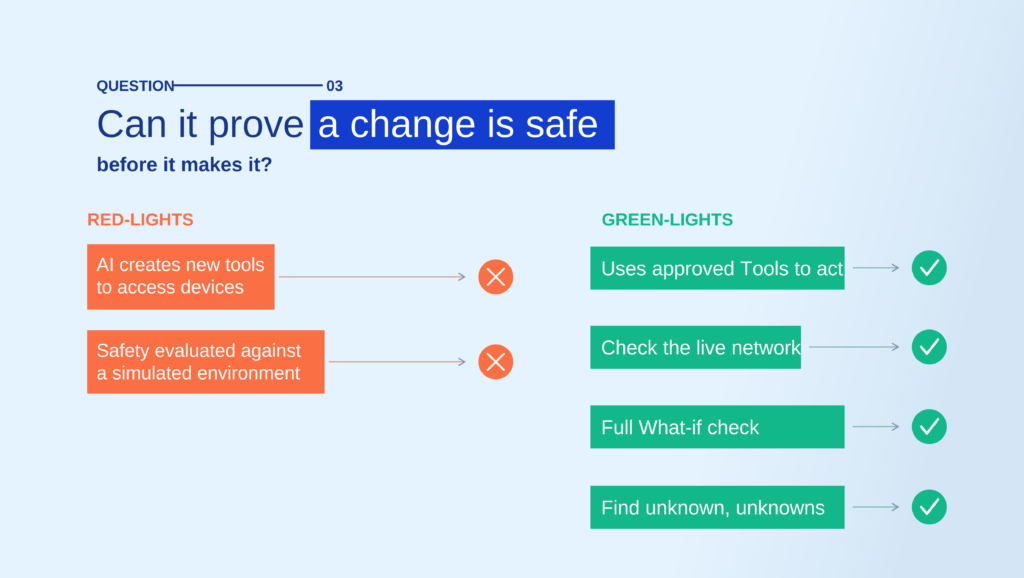
Years of work with thousands of the world’s most complex networks led us to build these capabilities, and more, into the NetBrain Agentic NetOps Platform. Our Change Agent makes pre- and post-change checks routine. It’s grounded by our NetOps Harness, which provides the guardrails, tools and live network data behind every agent. The human is still in the loop to review and approve the change, or not. But the pressure and cognitive load no longer sit on your network team alone.
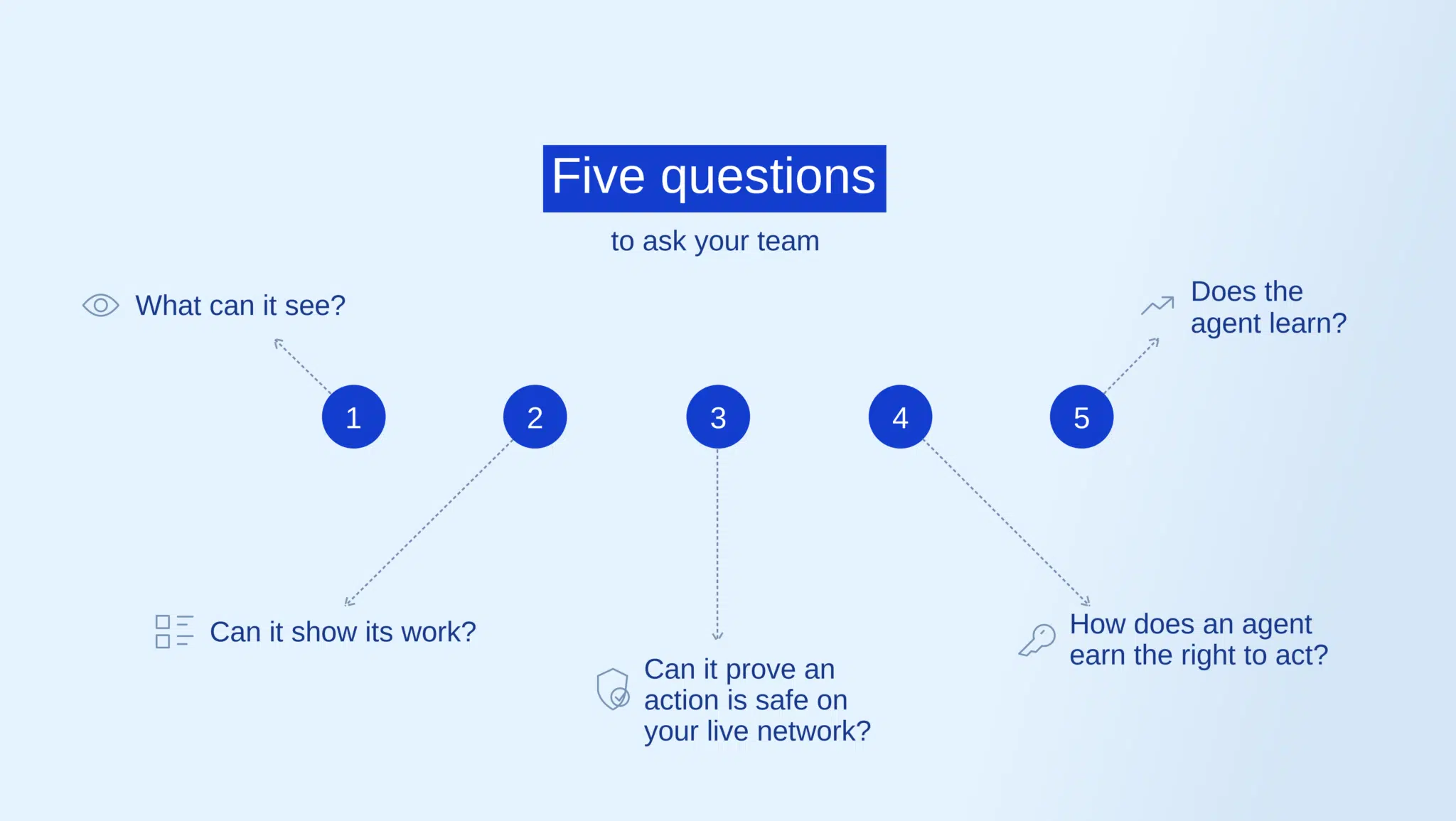
Before you trust an AI agent’s answer about your next change, ask five questions. I closed my talk at the Gartner IT Symposium in Barcelona last week with them.
These questions are demanding on purpose and most products fail at least 2 of these tests.
Ask them about the tools your team uses or is evaluating, then see how NetBrain answers all five. Pay closest attention to the third. It’s the one that keeps your next change from becoming your next outage.