The Substitution Decision: How Agentic NetOps Changes What You Need From Your Network Team
The best teams at the 2026 World Cup won’t be the ones with the most stars. They’ll be the ones with the best depth and support strategy. Great teams win...

In early 2017, a bit of a groundswell began around the concept of intent-based networking (IBN). By June, it had become one of the hotter topics in the world of networking, fueled largely by Cisco’s announcement in June and their subsequent push at Cisco Live in July. By early July, Gartner had received so many inquiries around the topic that research vice president Andrew Lerner posted an FAQ detailing the state of the IBN market.
So, what is IBN and why all the hype?
In short, IBN systems operate by a method where network engineers tell the network what tasks need to be done. Then, the network itself determines how those tasks are completed. Through automation, the actions required to enact network changes are made without engineer intervention. The changes are continuous, ensuring that they will be carried forward whether workers move or not.
As an example, imagine a scenario where an organization wants to route all traffic from a given location through a network channel. The engineer could simply provide the network with a command, and through a combination of IBN software and automation, all the technical settings are adjusted and the task is completed.
As great as that sounds, there is still a large element of uncertainty for network engineers when it comes to implementing IBN systems. Ceding control of the network change management process is not something to be taken lightly, especially considering the potential damage that misconfigured network settings can cause. However, there may be a compromise that works for all.
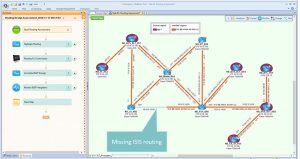
NetBrain can automatically verify and validate changes visually to ensure there are no adverse effects as a result of the automated changes. This is a best-of-both-worlds scenario where are all the manual, time-consuming tasks are offloaded from the engineers and automated through an IBN system. However, the network engineer maintains oversight to ensure no changes have unintended consequences on the network.
Intent-based networking is nascent, but could be the next big thing in networking, as it promises to improve network availability and agility, which are key as organizations transition to digital business.
— Andrew Lerner, research vice president, Gartner
As Lerner suggests, intent-based networking systems (IBNS) are not new, and in fact, the ideas behind IBNS have been around for years. What’s new is that machine learning algorithms have advanced to a point where IBNS could become a reality soon.
That is not to say that these systems will be beyond reproach from day one. Having a system in place that can perform automated checks and balances on your IBN can not only save a lot of time in the short term, but a great deal of pain down the road.
Yes, compromise can be good.